Metaversum and Digital Games Business | GoVersity

Prof. Dr. Giovanni Vindigni
Professor of Digital Games Business
19. Oktober 2022
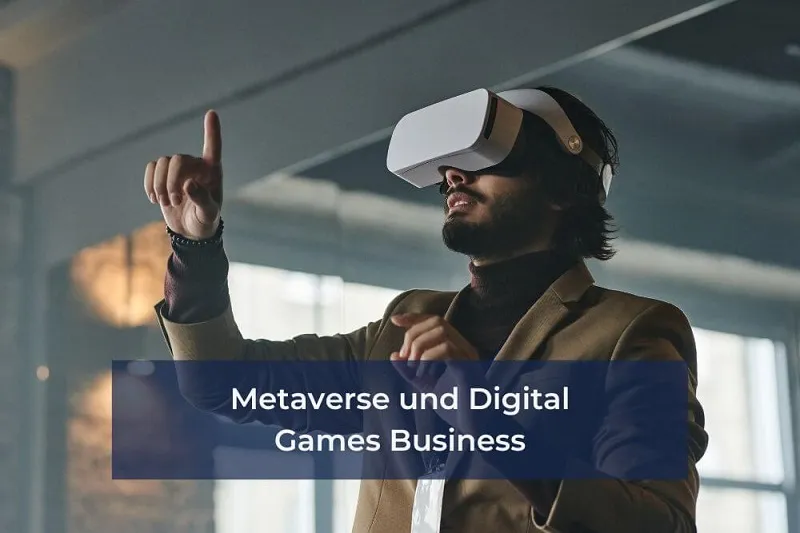
Are you interested in the metaverse and would like to study something in this field? Then the Bachelor’s degree program in Digital Games Business is just right for you. If you are wondering what Metaverse has to do with Digital Games Business, Dean of Studies Prof. Dr. Giovanni Vindigni explains the connections in detail below:
As part of a Research doctorate 712 empirical respondents, i.e. so-called ‘casual gamers’ (m/f/d) residing in Germany and executives from the games biz, were asked about various contextual factors relating to the future of the German-speaking games industry, including the question of how they classify the constantly evolving and emergent metaverse. As this cyber-physical and immersive living and working space is still in its early stages and the experts have very different interpretations of aspects such as organizational participation, anticipation, information technology architecture, questions about game mechanics and theory, etc., the layperson is certainly justified in asking how the functioning of this media technology phenomenon can be both interpreted and communicated to the outside world.
What is the core connection between the metaverse and the games biz?
Metaverse is an interactive 3D virtual world based on the cyber-physical principles of Web 3.0 and aims to provide consumers with a holistic, audible, visible and tangible 3D immersive entertainment experience. The experts agreed that in the current phase of the metaverse, the games industry is currently playing a relevant role in the new era of the Internet and will continue to do so in the future. Game developers, publishers, streaming providers and gamers (m/f/d) assume that the games biz is the actual driving force behind the invention (technically an invention or development that does not yet represent a procedural or normative innovation) of the metaverse in the current reality of leisure and work. The experts also agreed that it should be assumed that all companies in all economic segments will have to establish a metaverse presence in the near future in order to remain economically and organizationally connected and capable of acting with regard to their target groups.
In the past, various game developers have already developed the first prototypes of the metaverse in co-production. This fact alone underlines the fact that their position as the above-mentioned inventors is known throughout the industry. For example, the highly successful games such as Minecraft or the free-to-play game Fortnite as well as the industry-established online gaming platform Roblox integrate numerous aspects of the metaverse, including virtual worlds in which gamers can meet to play and build a community and use synchronous network social communication functions for sharing within the game.
Increasingly, numerous games companies are offering in-game payment systems and intangible goods virtually, such as clothing, skins, performance-enhancing props, weapons and vehicles, which also enable gamers (m/f/d) to access games regardless of platform or device. Games thus become social spaces in which the players form a collaborative, playful and thus rule-based community of practice (CoP) as an ecosystem, which is sustainable and thus target group-oriented.
While companies from different sectors, including universities in this country with different orientations, are currently finding it difficult to imagine new fields of business and activity within the metaverse, executives from the games biz see enormous potential for growth, as the Bundesverband Game e. V. as a result of several presentations at this year’s Gamedevcom DDC 2022 (a game developer conference in Germany). When asked about the possible advantages and organizational opportunities of gaming in the metaverse, the experts not only see options with regard to new business models, but also recognize, as mentioned above, a sustainable, target group-oriented, but above all a communication-positioning and closer relationship between brands and customers as an ecosystem per se.
Furthermore, it must be stated that the metaverse serves the participative development of so-called customer-integrative models, such as user innovation and open innovation as collaborative and reciprocal co-creation aspects, which are existentially important for the games biz, among other things due to the very considerable shortage of skilled workers in this industry. The customer is thus transformed much more intensively into a hybrid construct of customer and producer, towards a participative prosumer, as a result of the structure and guiding idea of the metaverse. The introduction of new products and services, the improvement of customer relationship management and the development of new communities (CoP) within the existing customer base present very significant opportunities in this context, as can be seen from the evaluations of the research work.
In order to remain organizationally connected, innovative and future-proof as an industry, also with regard to the employability of employees, game developers and publishers must rethink both their product portfolio and their personnel investments. The experts specified that they therefore prioritize investments in virtual (VR), augmented (XR) or mixed (MR) reality experiences. These technologies will play a prominent role when it comes to the complexity-reducing user experience according to DIN EN ISO 9241 in order to help users engage with the metaverse and get them more involved, especially in its current initial phase of the metaverse. Nonetheless, futurologists and even the World Economic Forum (WEF) in Davos are saying that it is quite possible to imagine an emerging era in which a similar level of interactivity will be possible while at the same time reducing complexity in terms of the technologies used and improving usability. Prof. Dr. Klaus Schwab, Founder of the WEF, said: “The Metaverse will influence the way people, governments, businesses and society at large think, work, interact and communicate to collectively address the issues on the global agenda. The Global Collaboration Village will be an extension of the World Economic Forum’s public-private platforms and face-to-face meetings, enabling a more open, sustainable and inclusive process of coming together.”
The experts from the games industry specified that their employees therefore need a new mix of skills in order to be able to exploit the full potential of the metaverse. This in turn means that game developers and game publishers have to take a different approach when hiring new employees because they need new skills. This also underlines the need for both customer integration approaches and community management to be important contextual factors that need to be implemented organizationally. At the same time, however, consideration must also be given to incentives with regard to customer participation models.
Cryptogames, blockchain and NFTs in the metaverse
The interplay between the real and virtual economy is increasingly taking shape. The media-convergent integration of various technologies, particularly by means of blockchain, is blurring the boundaries more than ever and giving rise to new forms of economic activity. Digital assets, including non-fungible tokens (NFTs), are an important component of the meta-economy within the metaverse.
NFTs are a relatively new development that has the potential to revolutionize several traditional industries by convergently hybridizing the real world with the virtual. The underlying concept of NFTs is to create a certain scarcity and individuality in the flood of the seemingly endless supply of virtual items. This very often succeeds not in buying an intangible work itself, but a non-fungible token (NFT) that can be used to track ownership and scarcity of digital works such as those below.
NFTs are therefore unique assets that are stored on a blockchain, such as Ethereum, Bitcoin Polygon or Solana. They serve as verifiable and plausible documents for the purpose of ownership, which, however, only exists in the virtual world. Storing them on a public blockchain provides security and authenticity and enables the mobility of NFTs in various applications.
Because NFTs authenticate ownership of virtual items and represent value both now and in the future, they are poised to become a universal store of value for the metaverse.
NFT value creations have recently attracted a lot of attention from the gamer (m/f/d) target group, as almost any item can be converted into an NFT. For example, this target group can buy NFTs for commodities such as virtual cars, weapons or skins for gameplay and even earn them with a value-added bonus. In virtual worlds such as the game product The Sandbox, there is already a booming gaming cryptocurrency market using NFTs. In this meta-world, users can create, develop, host and sell virtual properties. Each plot of land is effectively an NFT.
Outside of games, NFTs can also be collectibles or branded items, such as works of art. On December 1, 2021, the Cologne-based artist auction house Van Ham became the first dealer in Germany to auction a hybrid NFT called “GodPixel”, i.e. a photograph by the artist Gavin Evans. As NFTs continue to grow, they can increasingly be used as access cards for eSports events, clubs and other venues, as well as for digital experiences. Some brands offer their customers member benefits when using their NFTs, e.g. in the form of preferential access to future products and (virtual) experiences. The possibilities around NFTs are therefore unlimited. Furthermore, demonstrable ownership indicates that they can also be bought, sold or traded on secondary marketplaces such as OpenSea or Magic Eden.
NFTs allow the gamer community to retain full ownership of their digital assets, trade them with other players in the same publisher universe, sell them for real money and ultimately reuse them on multiple blockchains.
As a rule, NFTs are monetized through smart contracts. These are cyber-physical programs that are stored on a blockchain and are executed as soon as certain predefined conditions are met.
NFTs in the metaverse are also of phenomenological and game-theoretical importance in the context of an existing ecosystem community as a driving force with regard to the play-to-earn principle (P2E). Play-to-Earn enables gamers (m/f/d) to recognize a behavioral incentive, namely through monetization options, a value added (economic added value) in playing this game genre. This is in contrast to many conventional games where the assets acquired have no real value. In P2E games, gamers (m/f/d) are rewarded for their time and effort within a game by earning cryptocurrencies that can be used within the game, sold on an open market or monetized through smart contracts. For example, once a gamer (m/f/d) creates an NFT character that someone else uses to earn cryptocurrencies, the creator receives a portion of that income.
Digital assets not only offer quantitative business potential, but also qualitative potential. Increasing customer satisfaction, increasing profit margins, improving the visibility of products and services, improving collaboration and co-creation processes with non-traditional stakeholders and acquiring new customers.
NFTs enable the games market to create new forms of value creation and ownership. The games industry can also rely on a target group that is open to phenomena such as cryptocurrency and crypto gaming. NFTs therefore represent a trend because they utilize a core dynamic of cryptocurrency per se: The value of a token results from the reciprocal and joint consent of the users. This means that the community of practice (CoP) that is constituted around the NFT is based on the literal underlying values of that NFT. The owners also hope that NFTs will have a socially motivational effect on social recognition in this community. The more NFTs become part of people’s personal identity, the more the technology and the resulting assets will be utilized.
Why study Digital Games Business (B.A.)?
Games and game mechanics and models play a central role in the creation and expansion of the metaverse and newer ecosystems.
The principle of the metaverse will also play a major role in educational segments, i.e. in the learning and development industry in the truest sense of the word, as knowledge can be conveyed differently through virtually created artifacts. The metaverse will also play a profound role in brand promotion, customer loyalty and integration across the entire customer lifecycle. Rather, however, it should be stated that the reality of life, leisure and work will be transformed, including socio-economically, in the way people, NGOs, companies, governments and thus society per se interact in terms of systems theory.
Prof. Dr. Giovanni Vindigni
To summarize, the key connection between the metaverse and the gaming industry is that the gaming industry is the driving force behind the invention of the metaverse and that it offers numerous benefits and opportunities for companies in terms of new business models. Have you always wanted to work in the games industry and are looking for the perfect degree program?
Here you can find the Bachelor’s degree program in Digital Games Business, which you can study online and hybrid in Karlsruhe,
You can find more information on the games industry in the following reference book.
https://www.goversity.de/wp-content/uploads/2022/10/Metaverse-und-Digital-Games-Business-1.jpg 533 800 Giovanni Vindigni https://www.goversity.de/wp-content/uploads/2019/03/goversity-logo-header.png Giovanni Vindigni2022-10-19 11:52:512025-07-22 13:01:53What connects the metaverse with digital games business?
Kontakt
GoVersity GmbH
Verwaltung:
Im Zeitvogel 2
76227 Karlsruhe
Campus Karlsruhe
Durlacher Allee 56
76131 Karlsruhe
Tel.: +49 721 619 301 90
study@goversity.de
Individuelle Beratung und Bewerbung
Bei unseren Online-Info-Sessions kannst Du Dir in 30 Minuten persönlich ein Bild von den Angeboten der GoVersity machen und uns kennenlernen.
Du kannst Dich auch direkt für ein Bachelor- oder Master-Studium bewerben.
Sitemap
- Home page
- Bachelor
- Master
- Study concept
- Events
- Blog
- Contact & Community
- Info Session
- Application
- Study Navigator | GoVersity
- Doctorate PHD
- PhD Application
- Request our Tech Brochure
- PhD Doctoral Lounge
Bleib inspiriert mit Go-News
Mit unserem Newsletter (1x im Monat) halten wir Dich immer dem Laufenden
Link to: Podcast & transcript on the topic “Advertising psychology” Link to: Podcast & transcript on the topic “Advertising psychology” Podcast & transcript on the topic “Advertising psychology”Link to: The best apps for studying Link to: The best apps for studying The best apps for studying
Scroll to top Scroll to top Scroll to top
We are using cookies to give you the best experience on our website.
You can find out more about which cookies we are using or switch them off in settings.
Accept Settings
Change cookie settings
Close GDPR Cookie Settings
- Privacy Overview
- Strictly Necessary Cookies
- Analytics
- Marketing
- Cookie Policy
Privacy Overview
This website uses cookies so that we can provide you with the best user experience possible. Cookie information is stored in your browser and performs functions such as recognising you when you return to our website and helping our team to understand which sections of the website you find most interesting and useful.
Strictly Necessary Cookies
Strictly Necessary Cookie should be enabled at all times so that we can save your preferences for cookie settings.
Enable or Disable Cookies Enabled Disabled
Analytics
This website uses Google Analytics to collect anonymous information such as the number of visitors to the site, and the most popular pages.
Keeping this cookie enabled helps us to improve our website.
Enable or Disable Cookies Enabled Disabled
Marketing
This website uses the following additional cookies:
(List the cookies that you are using on the website here.)
Enable or Disable Cookies Enabled Disabled
Cookie Policy
More information about our Cookie Policy
Enable All Save Settings
{"@context":"https://schema.org","@graph":[{"@type":"Article","@id":"https://www.goversity.de/en/blog/what-connects-the-metaverse-with-the-digital-games-business/#article","isPartOf":{"@id":"https://www.goversity.de/en/blog/what-connects-the-metaverse-with-the-digital-games-business/"},"author":{"name":"Giovanni Vindigni","@id":"https://www.goversity.de/en/#/schema/person/c80d8e13b42ff349757a58204bca761c"},"headline":"What connects the metaverse with digital games business?","datePublished":"2022-10-19T09:52:51+00:00","dateModified":"2025-07-22T11:01:53+00:00","mainEntityOfPage":{"@id":"https://www.goversity.de/en/blog/what-connects-the-metaverse-with-the-digital-games-business/"},"wordCount":2098,"publisher":{"@id":"https://www.goversity.de/en/#organization"},"image":{"@id":"https://www.goversity.de/en/blog/what-connects-the-metaverse-with-the-digital-games-business/#primaryimage"},"thumbnailUrl":"https://www.goversity.de/wp-content/uploads/2022/10/Metaverse-und-Digital-Games-Business-1.jpg","articleSection":["Future"],"inLanguage":"en-US"},{"@type":"WebPage","@id":"https://www.goversity.de/en/blog/what-connects-the-metaverse-with-the-digital-games-business/","url":"https://www.goversity.de/en/blog/what-connects-the-metaverse-with-the-digital-games-business/","name":"Metaversum and Digital Games Business | GoVersity","isPartOf":{"@id":"https://www.goversity.de/en/#website"},"primaryImageOfPage":{"@id":"https://www.goversity.de/en/blog/what-connects-the-metaverse-with-the-digital-games-business/#primaryimage"},"image":{"@id":"https://www.goversity.de/en/blog/what-connects-the-metaverse-with-the-digital-games-business/#primaryimage"},"thumbnailUrl":"https://www.goversity.de/wp-content/uploads/2022/10/Metaverse-und-Digital-Games-Business-1.jpg","datePublished":"2022-10-19T09:52:51+00:00","dateModified":"2025-07-22T11:01:53+00:00","description":"Metaverse and Digital Games Business - Cryptogames, Blockchain and NFTs in the Metaverse - Why a Digital Games Business (B.A.) degree program?","breadcrumb":{"@id":"https://www.goversity.de/en/blog/what-connects-the-metaverse-with-the-digital-games-business/#breadcrumb"},"inLanguage":"en-US","potentialAction":[{"@type":"ReadAction","target":["https://www.goversity.de/en/blog/what-connects-the-metaverse-with-the-digital-games-business/"]}]},{"@type":"ImageObject","inLanguage":"en-US","@id":"https://www.goversity.de/en/blog/what-connects-the-metaverse-with-the-digital-games-business/#primaryimage","url":"https://www.goversity.de/wp-content/uploads/2022/10/Metaverse-und-Digital-Games-Business-1.jpg","contentUrl":"https://www.goversity.de/wp-content/uploads/2022/10/Metaverse-und-Digital-Games-Business-1.jpg","width":800,"height":533},{"@type":"BreadcrumbList","@id":"https://www.goversity.de/en/blog/what-connects-the-metaverse-with-the-digital-games-business/#breadcrumb","itemListElement":[{"@type":"ListItem","position":1,"name":"Startseite","item":"https://www.goversity.de/en/home-page/"},{"@type":"ListItem","position":2,"name":"What connects the metaverse with digital games business?"}]},{"@type":"WebSite","@id":"https://www.goversity.de/en/#website","url":"https://www.goversity.de/en/","name":"GoVersity","description":"Bachelor-Studium, Master-Studium, Promotion","publisher":{"@id":"https://www.goversity.de/en/#organization"},"potentialAction":[{"@type":"SearchAction","target":{"@type":"EntryPoint","urlTemplate":"https://www.goversity.de/en/?s={search_term_string}"},"query-input":{"@type":"PropertyValueSpecification","valueRequired":true,"valueName":"search_term_string"}}],"inLanguage":"en-US"},{"@type":"Organization","@id":"https://www.goversity.de/en/#organization","name":"GoVersity","url":"https://www.goversity.de/en/","logo":{"@type":"ImageObject","inLanguage":"en-US","@id":"https://www.goversity.de/en/#/schema/logo/image/","url":"https://www.goversity.de/wp-content/uploads/2019/03/goversity-logo-header.png","contentUrl":"https://www.goversity.de/wp-content/uploads/2019/03/goversity-logo-header.png","width":400,"height":175,"caption":"GoVersity"},"image":{"@id":"https://www.goversity.de/en/#/schema/logo/image/"},"sameAs":["https://www.facebook.com/GoVersitySteinbeis","https://www.instagram.com/goversity.steinbeis"]},{"@type":"Person","@id":"https://www.goversity.de/en/#/schema/person/c80d8e13b42ff349757a58204bca761c","name":"Giovanni Vindigni","image":{"@type":"ImageObject","inLanguage":"en-US","@id":"https://www.goversity.de/en/#/schema/person/image/","url":"https://secure.gravatar.com/avatar/d8ac4349861780f0dd47456c68e3fd1731277f1505ab5cad1aa2aa8d805efc88?s=96&d=mm&r=g","contentUrl":"https://secure.gravatar.com/avatar/d8ac4349861780f0dd47456c68e3fd1731277f1505ab5cad1aa2aa8d805efc88?s=96&d=mm&r=g","caption":"Giovanni Vindigni"},"url":"https://www.goversity.de/en/blog/author/vindigni/"}]}
{
    "@context": "https://schema.org",
    "@type": "LocalBusiness",
    "@id": "https://www.goversity.de/en/",
    "image": "https://www.goversity.de/wp-content/uploads/2019/03/goversity-logo-header.png",
    "priceRange": "$$",
    "telephone": "+49 721 619 301 90",
    "name": "GoVersity",
    "logo": "https://www.goversity.de/wp-content/uploads/2019/03/goversity-logo-header.png",
    "description": "GoVersity bietet mit einem exklusiven akademischen Netzwerk, berufsbegleitende Bachelor, Master/MBA -Studienprogramme an. Diese zeichnen sich durch hohe Praxisorientierung, ein flexibles Studienkonzept und individuelle Karrieref\u00f6rderung aus. Das ist, dass 360-Grad GoVersity Konzept. Hochqualifizierte Dozenten aus der Unternehmenspraxis vermitteln moderne Studieninhalte, die eine langfristige berufliche Perspektive und Sicherheit verfolgen. Alle Programme sind akkreditiert und staatlich anerkannt. Sie umfassen u.a. die Bereiche Betriebswirtschaftslehre (BWL), Management, Wirtschaftspsychologie, Marketing mit dem akademischen Abschluss Bachelor of Arts (B.A.), Master of Arts (M.A.)/ Master of Business Administration (MBA).",
    "openingHours": [
        "Mo-Fr 09:00-20:00",
        "Sa 10:00-20:00"
    ],
    "geo": {
        "@type": "GeoCoordinates",
        "latitude": null,
        "longitude": null
    },
    "url": "https://www.goversity.de",
    "contactPoint": {
        "@type": "ContactPoint",
        "telephone": "+49 721 619 301 90",
        "contactType": "customer service",
        "email": "",
        "contactOption": "",
        "areaServed": "",
        "availableLanguage": null
    },
    "address": {
        "@type": "PostalAddress",
        "addressCountry": "Germany",
        "addressLocality": "Karlsruhe",
        "addressRegion": "Baden-W\u00fcrttemberg",
        "postalCode": "76227",
        "streetAddress": "Im Zeitvogel 2"
    }
}